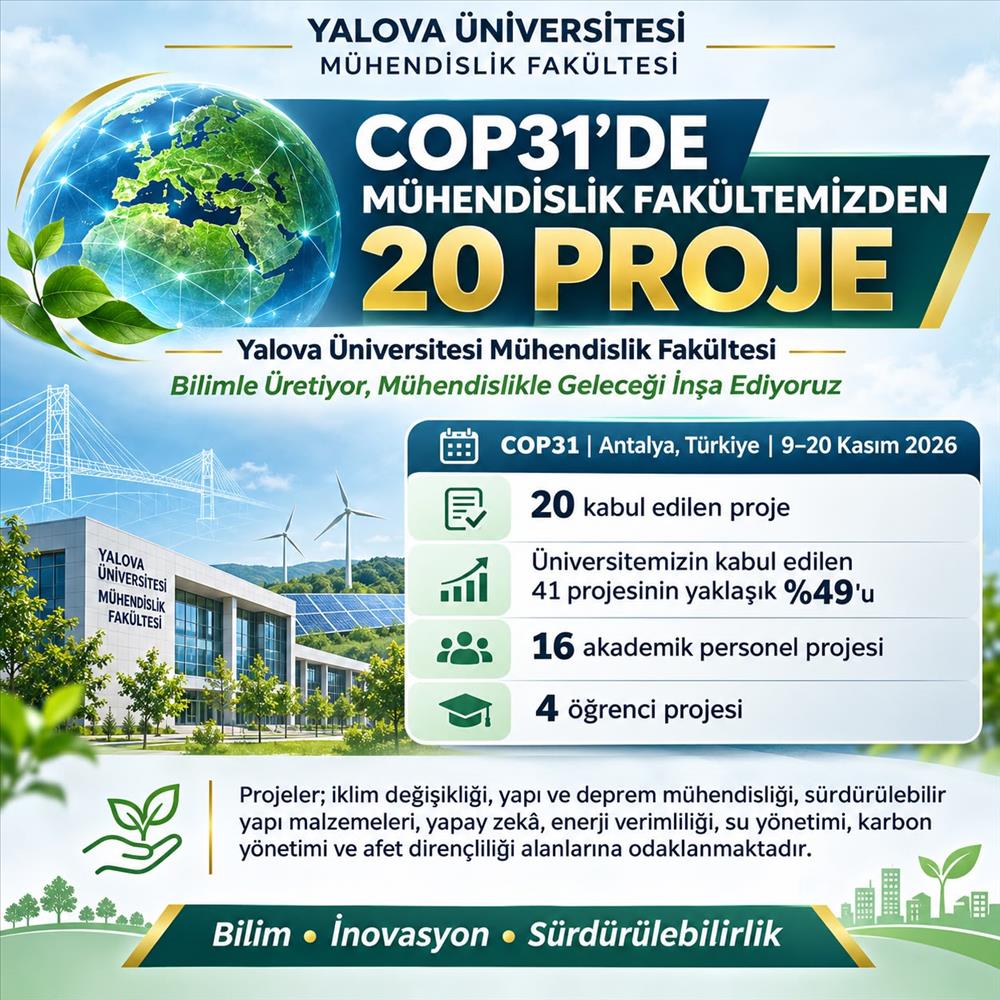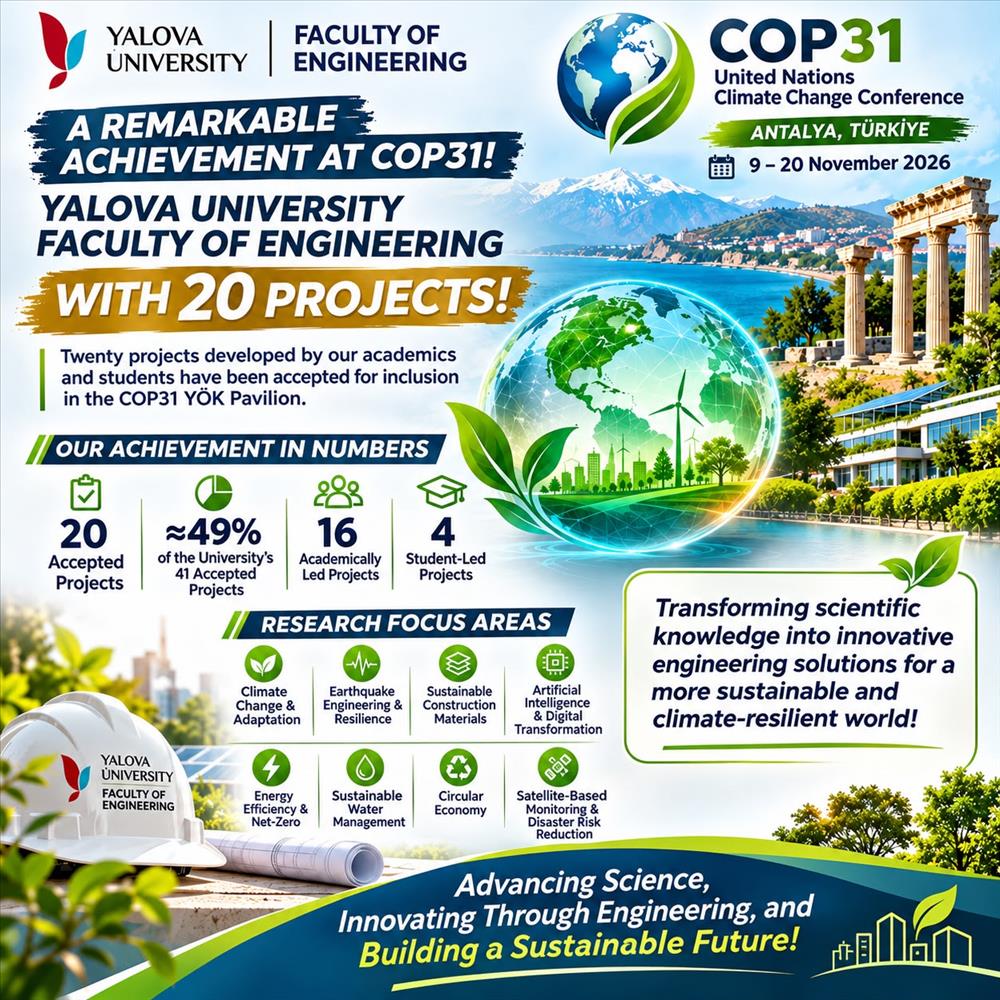
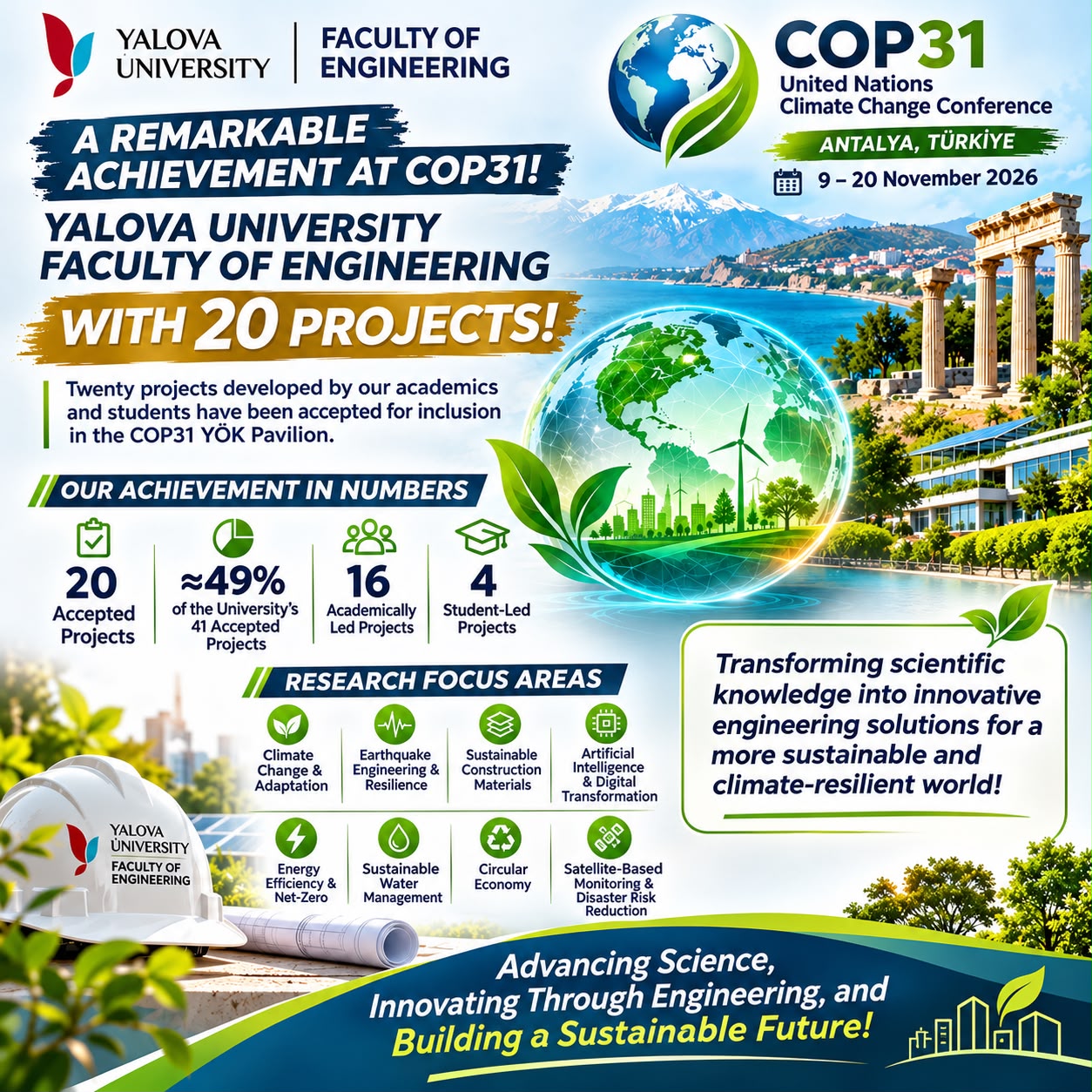
Twenty innovative projects developed by academics and students from the Faculty of Engineering have been accepted for inclusion in the COP31 Pavilion coordinated by the Turkish Council of Higher Education.
Yalova University Faculty of Engineering has achieved a significant academic milestone with 20 projects accepted for inclusion in the COP31 Pavilion coordinated by the Turkish Council of Higher Education (YÖK), as part of the 31st United Nations Climate Change Conference (COP31), held in Antalya, Türkiye, from 9 to 20 November 2026.
Following the academic evaluation process coordinated by YÖK, 41 projects submitted by Yalova University were accepted for inclusion in the COP31 YÖK Pavilion.
Of these 41 accepted projects, 20 were developed by academics and students from the Faculty of Engineering, representing approximately 49% of the University’s total accepted projects.
This significant achievement demonstrates the Faculty’s scientific research capacity, interdisciplinary expertise, and strong commitment to addressing global challenges through innovative engineering solutions.
Advancing Sustainability Through Science, Technology, and Engineering
The accepted projects cover a broad spectrum of scientific and technological disciplines, including structural and earthquake engineering, climate-resilient infrastructure, sustainable construction materials, artificial intelligence, machine learning, energy efficiency, carbon footprint assessment, circular economy, sustainable water management, satellite-based environmental monitoring, and disaster risk reduction.
Research addressing the impacts of climate change on structural design, sustainable reconstruction in earthquake-affected regions, low-carbon construction technologies, and climate-resilient infrastructure highlights the essential contribution of engineering sciences to climate change mitigation and adaptation.
In addition, projects involving digital transformation, microalgae technologies, sustainable campus development, carbon management, and green industrialisation demonstrate the Faculty’s commitment to transforming scientific knowledge into innovative and practical solutions with environmental, economic, and societal benefits.
Through these interdisciplinary initiatives, the Faculty aims to contribute to the development of safer, more sustainable, resource-efficient, and climate-resilient communities.
A Collective Academic Achievement: 16 Academic-Led and 4 Student-Led Projects
Of the 20 projects accepted from the Faculty of Engineering, 16 are led by academic staff members, while four are led by students.
A total of nine academic staff members and four students serve as project leads, representing the Faculty’s collaborative research environment and commitment to scientific excellence.
This achievement also reflects the importance of integrating students into scientific research, innovation, and international academic activities.
By encouraging interdisciplinary collaboration and research-oriented education, the Faculty continues to support the development of future engineers capable of addressing complex environmental and technological challenges.
Accepted COP31 Projects and Project Leaders from the Faculty of Engineering
1. Ten Minutes to 2035: AI-Based Net-Zero Campus Decision Simulation at the Energy–Climate Nexus (NetZero Decision Lab)
Project Lead: Özlem Akıncı – Student
2. Digitalisation and Sustainable Value Creation in Biorefinery Processes
Project Lead: Kaan Akgün – Student
3. Sustainable Building Approaches in Post-Earthquake Reconstruction: Feasibility of Net-Zero Energy Buildings in Earthquake-Affected Regions of Türkiye
Project Lead: Kadir Akbaş – Master’s Student
4. Interdisciplinary Sustainability Living Laboratory (ClimateLab)
Project Lead: Associate Professor Dr. Oya Irmak Cebeci
5. Experimental and Numerical Study Assessing the Synergistic Effect of Metakaolin and Waste Glass on Concrete Mechanical and Structural Properties
Project Lead: Associate Professor Dr. Çiğdem Avcı Karataş
6. Comparative Energy Performance Monitoring of Twin Buildings and Net-Zero Energy Campus Awareness Project
Project Lead: Professor Dr. Ümit Ünver
7. The Impact of Climate Change on Structural Design and Design Parameters
Project Lead: Associate Professor Dr. Çiğdem Avcı Karataş
8. Assessment of the Campus Carbon Footprint and Development of a Climate Action Plan (Campus Carbon Map)
Project Lead: Associate Professor Dr. Oya Irmak Cebeci
9. Sustainable Water Management Through the Utilisation of Campus Rainwater for Microalgae Production (Rain2Algae)
Project Lead: Associate Professor Dr. Oya Irmak Cebeci
10. Development of Carbonised Hemp Fibre-Based Wearable Sensors for Physiotherapy Applications
Project Lead: Associate Professor Dr. Ozan Toprakçı
11. Microalgae-Based Carbon Awareness and Sustainable Campus Demonstration System (Algae4Climate)
Project Lead: Associate Professor Dr. Oya Irmak Cebeci
12. Strategic Intervention and Prioritisation Approach for Cultural Territories
Project Lead: Associate Professor Dr. Çiğdem Avcı Karataş
13. Demand Management
Project Lead: Research Assistant Dr. Ayşe Polat
14. Low-Carbon Biocomposite Materials from Agricultural Waste: Zamia Composite for Circular Economy and Green Industrialisation
Project Lead: Associate Professor Dr. İdris Karagöz
15. Reaching Municipalities
Project Lead: Research Assistant Dr. İsmail Adalıoğlu
16. Global Analysis of Rainfall Triggers, Flood Dynamics, and Exposure Associated with Selected Urban Flood Events Using Satellite Observations and Open Data (GLOBAL-URBAN-FLOOD)
Project Lead: Assistant Professor Dr. Temel Temiz
17. Satellite-Based Global Assessment of Drought Resilience and Climate Adaptation of Large Reservoirs (SAT-RESILIENCE)
Project Lead: Assistant Professor Dr. Temel Temiz
18. University-Based Climate Leadership and Sustainability Education Programme (Young Climate Ambassadors)
Project Lead: Associate Professor Dr. Oya Irmak Cebeci
19. Sustainable Activated Carbon Production from Defatted Waste Coffee Grounds: Experimental Investigation and Machine Learning-Based Analysis of Adsorption Performance
Project Lead: Lecturer Dr. Merve Ceylan
20. GreenScale: Product Carbon Data and Supplier Maturity Assessment System for CBAM-Related Inputs in Export-Oriented Industries (Pilot)
Project Lead: Elif Nur Öksüz – Student
From Local Scientific Expertise to Global Climate Solutions
The United Nations Climate Change Conference (COP31) serves as an important international platform for advancing global cooperation, climate policies, and innovative solutions to the challenges posed by climate change.
The acceptance of 20 projects from the Faculty of Engineering for inclusion in the COP31 YÖK Pavilion represents a valuable opportunity to enhance the national and international visibility of the Faculty’s research activities, promote interdisciplinary collaboration, and encourage the development of sustainable engineering technologies.
These projects collectively demonstrate the essential role of engineering in supporting climate change mitigation, strengthening adaptation strategies, reducing environmental risks, and building climate-resilient communities.
The Faculty’s research initiatives are designed not only to investigate existing environmental and technological challenges but also to develop forward-looking solutions capable of responding to changing climatic conditions and evolving societal needs.
Strengthening Research Excellence, Interdisciplinary Collaboration, and Sustainable Development
Yalova University Faculty of Engineering continues to advance its research and development activities through scientific innovation, interdisciplinary cooperation, technological progress, and student engagement.
The Faculty’s strong representation within the COP31 framework reflects its dedication to contributing to the United Nations Sustainable Development Goals (SDGs), expanding academic collaboration, and supporting national and global sustainability priorities.
This collective achievement further strengthens the Faculty’s commitment to internationally relevant research, sustainable engineering practices, and the development of innovative solutions for future generations.
Yalova University Faculty of Engineering sincerely congratulates all academics and students whose projects have been accepted within the COP31 framework and wishes them continued success in their scientific endeavours.
The Faculty remains committed to advancing scientific knowledge, promoting engineering innovation, and contributing to a safer, greener, and more resilient future.
ADVANCING SCIENCE, INNOVATING THROUGH ENGINEERING, AND BUILDING A SUSTAINABLE FUTURE!
Yalova University Faculty of Engineering
COP31 | Antalya, Türkiye | 9–20 November 2026